Returning to his dwelling nation of Venezuela can be harmful for Gabriel Jimenez. The 31-year-old programmer has been living in exile in the United States for 2 years now, from the place he’s striving to push a cryptocurrency revolution in his nation with a digital coin referred to as Reserve.
The cryptocoin is meant to circumvent Venezuela’s notoriously excessive inflation and has been in circulation since March this 12 months. The socialist politicians ruling Venezuela “don’t have any options for our nation” and its depreciating authorized tender, the bolivar, he informed DW.
Officially charged with designing Venezuela’s first cryptocurrency three years in the past, Jimenez — then a youthful startup founder on the age of 27 — noticed a probability for each beating hyperinflation and taking clandestine revenge on the nation’s detested socialist authorities.
The story of the lifetime of now exiled cryptocurrency creator Gabriel Jimenez is one among massive hopes and excessive treason
Before the federal government of leftist chief Nicolas Maduro approached him about creating a digital coin, Jimenez was a part of Venezuela’s anti-government movement and took half in a number of road protests. At the time, the economic system of the oil-rich South American nation was already in free fall.
Petro: the world’s first state-backed cryptocurrency
Jimenez noticed a chance to change his nation from inside. If a Bitcoin-like cryptocurrency was accomplished proper, he believed, he may give the federal government what it wished — a method to bypass excruciating financial sanctions imposed by the Trump administration — whereas additionally stealthily introducing expertise that may give Venezuelans a measure of freedom.
The perilous experience transported Jimenez from the lifetime of an activist to the middle of Venezuela’s darkish establishments of energy. However, the world’s first state-owned digital coin, the Petro, he helped create did not change into the type of revolution he had hoped for.
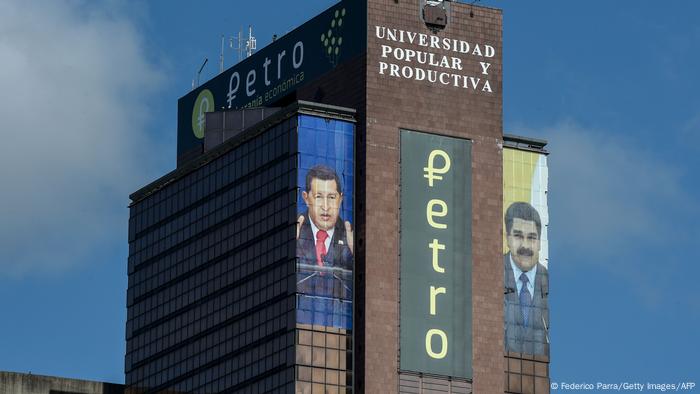
Venezuelan strongman Maduro (rigth) hopes the Petro can blunt the results of US sanctions and a do-it-yourself financial disaster
As the Petro is backed by Venezuela’s oil reserves, it breaks the tenets of Bitcoin and different cryptocurrencies, whose values do not derive from a pure useful resource or authorities fiat cash, however solely the legal guidelines of arithmetic. Before and after Petro’s launch in February 2018, Jimenez was additionally repeatedly compelled to change the token’s so-called white paper, stating on which blockchain platform the coin runs.
“I used to be naive on the time, and it is nonetheless hurting me to see how the petro is being misused as a political weapon by the federal government,” he mentioned, including that ultimately he was compelled to flee into exile to escape arrest and punishment.
Inflation and digital coin utilization going by way of the roof
Jimenez’s former dealings with the Maduro authorities have made him a controversial determine, who’s misplaced a lot belief inside the world cryptocommunity. And but, he says, he is nonetheless decided to struggle his nation’s spiraling inflation that compelled the federal government simply in March to difficulty a 1 million bolivar note — value about half a US greenback.
Last 12 months alone, the annual inflation price reached 6,500%, inflicting Venezuelans’ lifetime financial savings to go up in smoke, and accelerating their flight to the US greenback. According to Venezuelan assume tank Ecoanalitica, some 66% of all monetary transactions within the nation are already made within the US forex. At the identical time, cryptocurrency trades paid for with Venezuelan bolivar have been surging, information from cryptotrading platform NativeBitcoins exhibits.
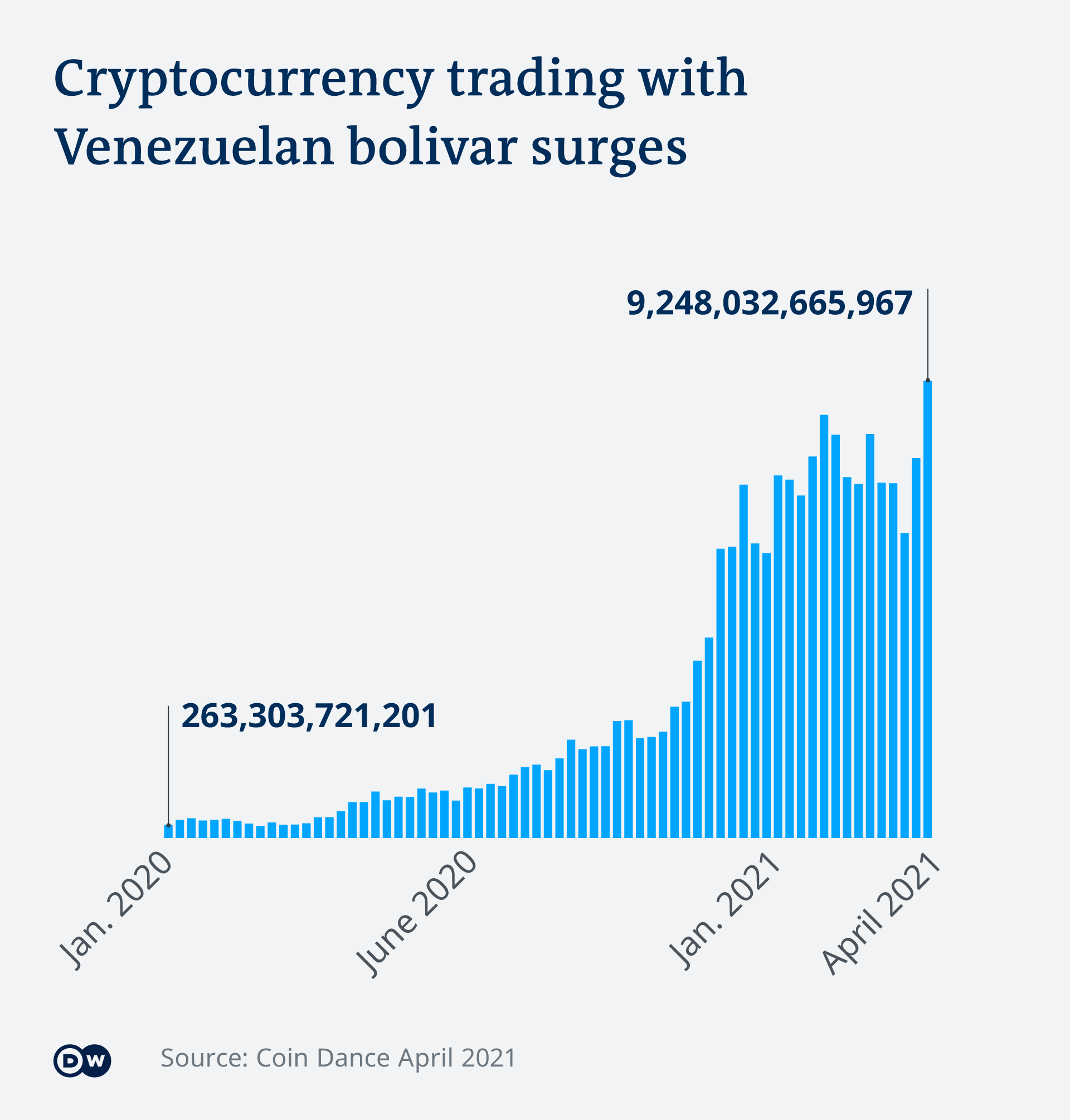
Blockchain analysts from New York-based Chainalysis additionally say cryptotraders from Venezuela are among the many most lively on this planet, rating shut to these within the US and Russia when it comes to peer-to-peer (P2P) dollar-based cryptotrading.
Jose Maldonado, a journalist who writes for crypto news platform Cointelegraph, says it is even attainable to pay road distributors with digital cash in some greater Venezuelan cities like Caracas, Maracaibo or Valencia. The pattern was additionally spreading to conventional brick-and-mortar shops, he informed DW in an electronic mail.
“Whether it is furnishings, clothes or groceries — nearly every part will be bought with cryptocurrencies,” he mentioned, including that Venezuelans’ cash of selection are primarily Bitcoin, Ether, Dash and Eos. Cryptocurrency trade Binance, he famous, had in the meantime change into as properly often known as the nation’s largest industrial financial institution, Banco de Venezuela.
Plaything of the well-heeled, expats and the federal government
In Venezuela, it is primarily the elites and members of the higher center class who can afford to dabble in cryptocurrencies. Internet connections in lots of components of the nation are sometimes too poor to permit entry to coin buying and selling. “For a majority of the inhabitants, utilizing digital currencies stays an phantasm,” mentioned Maldonado.
Still, cryptocurrencies are a monetary lifeline for a lot of Venezuelans, as they’re a straightforward and reasonably priced method for his or her kin in exile to ship cash dwelling. Widespread discontent with the nation’s socialist rulers has compelled 5 million Venezuelans, out of an total inhabitants of 30 million, to go away their nation.
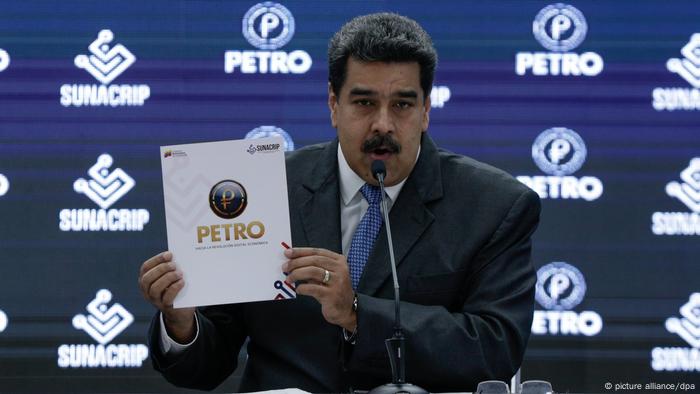
The Venezuelan president is utilizing the Petro as a propaganda instrument to enhance public help for his social coverage
Petro struggling for recognition
At the top of final 12 months, about 8 million public staff have been paid half a Petro every, roughly $30, as a Christmas bonus. Those who wished to get it had to register on an web platform of the federal government. Since this 12 months, tax funds may also be made utilizing Petros.
The authorities’s drive to promote the utilization of its digital token appears to be bearing fruit. Gas station operators reported in mid-2020 that about 15% of all gas funds have been made with the Petro. There are, nevertheless, additionally reviews that state officers are more and more utilizing the token to switch their riches overseas, as a result of, equally to Bitcoin, digital coin trades are a perfect method to secretly stash away ill-gotten cash.
Gabriel Jimenez thinks engaged on the Petro challenge was a mistake — one which pushes him to “work tougher” to make up for it. The solely good factor that has come out of it, he mentioned, was a wider acceptance of cryptocurrencies in Venezuela. Although rising slowly among the many inhabitants at massive, those that are utilizing digital cash are step by step regaining ever greater components of their monetary freedom. And even when the danger of untamed swings of their worth is excessive, he mentioned, cryptocurrencies are nonetheless a worthwhile funding, given the seemingly endless slide of Venezuela’s official forex.
This article was tailored from German.