George Ferns, Lecturer in Management, Employment and Organisation, Cardiff University, Marcus Gomes, Lecturer in Organisation Studies and Sustainability, Cardiff University.
_____
The local weather disaster is definite to be a sizzling matter on the G7 summit in Cornwall. While the leaders of the world’s richest international locations agree in principle on the necessity to attain internet zero emissions by 2050 on the newest, they continue to be faithful to a fossil fuel industry reluctant to substantively change its enterprise mannequin.
A latest report by the International Energy Agency, a typically conservative advisory body, argued for a direct ban on new fossil gas initiatives. But investments by oil, gasoline and coal corporations into discovering new sources continue, as does trade lobbying to undermine regulation.
The surroundings ministers of the G7 international locations dedicated to finish funding for new overseas coal projects by the tip of 2021. But 51% of their COVID-19 economic recovery funds – a complete of USD 189bn – paid between January 2020 and March 2021 had been earmarked as monetary help for the fossil gas trade. Worse, USD 8 of each USD 10 devoted to non-renewable vitality was paid with no circumstances on these corporations to reduce their emissions.
Why does it appear so laborious for G7 leaders to match their phrases with motion in relation to the fossil gas trade?
Betting on the long-term enterprise case
Despite setbacks in unstable markets and oversupply dangers, there’s nonetheless a lot of money to be produced from extracting, producing and promoting hydrocarbons. Demand for coal has plateaued, but oil and gasoline demand is predicted to rise no less than for the next 15 to 20 years, significantly in rising economies akin to China and India.
This places G7 leaders in a clumsy place. On the one hand, governments must reboot financial development after the pandemic slowdown – a worthwhile vitality sector nourished by rising demand overseas is welcome, though hydrocarbon extraction will be particularly polluting in developing countries.
Governmental assist for the trade within the type of subsidies or tax breaks artificially inflates the profitability of fossil fuels, in flip making renewables a much less enticing funding. Put merely, it is less risky and more profitable to – no less than for now – spend money on oil and gasoline.
Read extra:
Shell ordered to cut its emissions – why this ruling could affect almost any major company in the world
Carbon lock-in
The fossil gas trade continues to shed public support, but it may depend on the truth that it’s embedded inside a posh system of shoppers, suppliers and contractors, politicians and the media. The cause-and-effect relations that outline such an intricate system usually produce unintended outcomes.
This interdependency is known as carbon lock-in. Economies have advanced in such a manner that they perpetuate an vitality panorama dominated by fossil fuels and suffering from an incapability to transform.
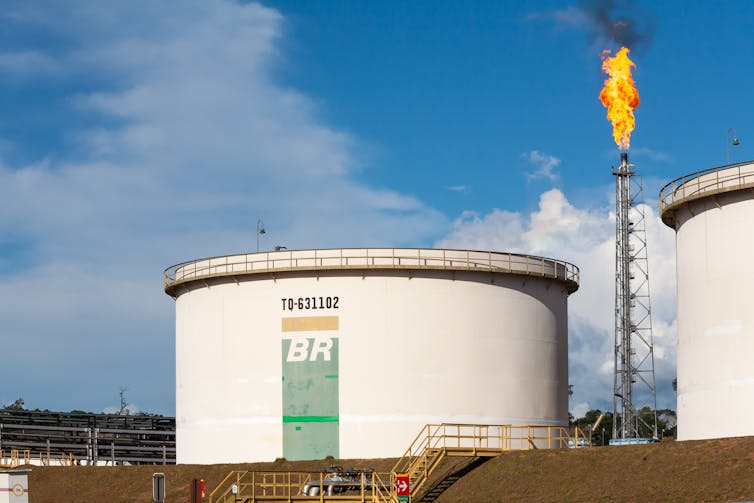
Not solely does carbon lock-in end in inertia, it causes a tragedy of the commons-type problem. Big oil corporations akin to BP, Exxon Mobil and Shell are unlikely to make significant modifications till the remainder of the system acts in unison. National oil corporations and smaller privately owned fossil gas corporations comprise the bulk of known fossil fuel reserves. But they usually evade the highlight and so can function with extra freedom. For a giant oil firm to make high-risk modifications to its enterprise mannequin whereas others get pleasure from a free journey can be seen as a nasty enterprise choice.
Paralaxis/Shutterstock
Lock-in, because the identify suggests, may be very tough to interrupt. That stated, G7 members are highly effective nodes inside this complicated community. Strong leadership – akin to divestment from fossil fuels and robust assist for renewables – would trigger reverberations all through the entire system. But sturdy commitments coupled with counter-intuitive insurance policies solely ship a sign that significant modifications aren’t coming.
Identity disaster
People working within the fossil gas trade usually keep within the sector for his or her complete profession – beginning off as college students of engineering or geoscience in departments funded by the industry, working all around the world after which heading into administration positions.
The trade’s id relies on sure values which have existed for the reason that early days of hydrocarbon exploration, together with, as one study found, a deep belief within the potential of science and expertise to additional humanity’s management over nature and to drive progress and financial improvement.
The ideological commitments of leaders within the fossil gas trade will take a agency problem from governments to beat. It’s clear from monetary choices within the lead as much as the summit that G7 leaders aren’t fairly as much as that take a look at but. But the assembly in Cornwall is their alternative to sign that that cosy relationship is lastly coming to an finish.
This article is republished from The Conversation below a Creative Commons license. Read the original article.
____
Learn extra:
– Moving to Green Bitcoin May be Moving To a Two-Tier Bitcoin
– Green Investments Help Bitcoin Miners Amid Possible Regulatory Crackdown
– Proof-Of-Bitcoin Needed As Critics & Competitors Unite To Play Climate Card
– A Closer Look on the Environmental Impact of Bitcoin Mining
– Rainy Season Will Test Just How Watertight China’s Bitcoin Mining Ban Is
– ‘Fiat-Like’ Proof-of-Stake Chains Favor Centralization & Rich Players